Imagine heading into the mountains in a jacket that promises to keep you warm up to a point. Down to minus ten degrees you feel nothing. But the jacket is also a bit tight: if the weather turns out wonderfully warm, you can’t take the sleeves off. Buffer ETFs work more or less like that, and it is worth understanding exactly what you are wearing.
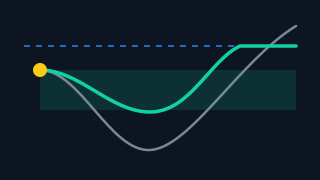
The technical name is “defined outcome ETF”, but the idea is simple. A regular S&P 500 ETF rises when the market rises and falls when the market falls, with no filter. A buffer ETF makes a different deal: it agrees to absorb the market’s first losses, for example the first ten percentage points, and in exchange gives up part of the gains. The maximum gain is called the cap, and it is set at the start.
To do this it uses options, contracts that work a bit like insurance. The ETF buys protection against losses, but someone has to pay for it, and the payment is exactly the gains the ETF gives up above the cap. There is no magic: the protection is not free, you pay for it with the upside you won’t get.
Let’s take an example. It is hypothetical and only meant to show how the mechanism works. Imagine an ETF with a 10% buffer and an 8% cap, for one year. If the market is up 20% at the end of the year, you gain 8%. The rest is not yours. If the market falls 6%, the buffer absorbs all of it and you end the year roughly flat. If the market falls 25%, the buffer covers the first ten points and you feel all the rest: you lose about 15%. Better than the index, but hardly painless.
This is where many people get the wrong idea. The buffer is not a capital guarantee. It is limited protection with a precise boundary. When the fall goes beyond it, the extra loss is all yours.
Then there is a detail that is easy to miss: time. Buffer and cap apply to a defined period, usually a year or a quarter, and then start over. If you buy the ETF on the first day of the period, the rules are the ones stated. If you buy halfway through, you may find a market that has already risen and a cap that is almost used up, or a market that has already fallen and protection that is partly used. It is like boarding a moving train: the ticket is the same, but the part of the journey left to you is different. That is why, before buying, it is worth checking on the issuer’s website how much protection and how much room for gains are really left at that moment.
And in practice, how has it gone? The best-known buffer ETFs are American, listed in the United States: the first family was launched in 2018 by Innovator, and it has the longest track record, so the most instructive one. In 2022, a year of sharp declines, a buffer on small US companies lost about 7.7% while its benchmark index lost about 20%: the parachute worked. On the other hand, in the year to June 2026 the US version of the iShares Max Buffer returned about 7%, against more than 22% for its benchmark index: when the market races ahead, protection comes at a high price. And in April 2025, during the sharp market drop, one of the largest buffer ETFs lost about 2.6% in a month, even though its protection was about 19%. The reason is that the protection applies to the result at the end of the period, not to every single day: along the way the price can still fall, and anyone who sells before the end may not get the protection they expected. If instead you hold until the end of the period, having bought at the start, the result tends to come close to the stated one: a loss along the way can be recovered, as long as the index does not close beyond the buffer. These are US figures, and past ones. In Europe these ETFs are new and have only a few years of history, so they tell us nothing about how the European ones will perform.
That leaves costs. These products are more complicated to build, and it shows in the bill. The annual costs of buffer ETFs range roughly from 0.50% to 0.90% depending on the product, against 0.14% for a global ETF such as VWCE. The differences look small, but added up over the years they become a slice of your return.
So who are they for? No one in particular, and that is the honest answer. They can make sense for people who want to stay invested in the stock market but cope badly with swings, and who accept giving up part of the gains in exchange for a more predictable path. For anyone building a long-term portfolio with a regular savings plan, a simple, low-cost ETF usually remains the most straightforward route. The choice depends on how much the fear of losing weighs for you compared with the wish to gain.
Before considering one, the advice is always the same: read the issuer’s official documents, check the buffer, cap, length of the period and costs, and ask yourself whether you have really understood what you are buying. What you can’t explain to a friend in two minutes is probably not yet clear to you either.
If you want to look at two European examples, in the Horizon Catalogue you will find the Global X S&P 500 Quarterly Buffer, with a quarterly period, and the iShares US Large Cap Max Buffer Sep, with an annual period. The page shows price, chart and costs, so you can see how they move over time. The details of the buffer and cap currently in force, however, should be read on the issuer’s website. These are not buying recommendations: they are only examples to show how the rules change from one product to another.